Tag Archives: Management

Non-profits and the pitfalls of crappy technology.

old floppy disks

I’ve been thinking a lot about the need to address culture change at the process level.

While leaders often try to kick-start culture change with broad, company-wide initiatives, the reality of culture is in the processes and procedures of the day to day.  Individuals draw conclusions about what an organization values by observing work processes, evaluation systems and resource allocation decisions.  So as a leader, you have a much better chance of making meaningful change by focusing your attention on those things.

What does this have to do with the antiquated computers, piecemeal reporting systems and hand-me-down phone systems that are found in many non-profits?  I believe the lack of proper tools illustrates the culture of scarcity that pervades those organizations and can also be a first step in mitigating it.

As a former non-profit administrator, I am well aware that scarcity is a reality.  There are rarely enough funds to meet the community need, leaders are under pressure from funders to keep administrative costs unrealistically low, and the funds that are available are rightly prioritized for direct service.  I get all that.  But I also think that the scarcity mentality leads to complacency and the acceptance of a lower standard.

Team members need the proper tools and resources to do their jobs.  Ignoring this leads to a culture that undervalues employees while simultaneously expecting them to perform miracles.  Mission-driven organizations depend on the passion of committed employees and volunteers.  But passion only goes so far. Hit too many roadblocks in your daily work and eventually passion will burn out.

If you want to change your culture of scarcity, start at the most basic level.  Consider what tools would help your team do their job better and focus your attention there.  Is top-of-the-line hardware realistic, or even necessary?  Probably not.  But demonstrating to employees, even in small ways, that you care about making their jobs easier goes a long way.


You might also like:

Are you meeting your team’s needs?

 

On optimism.

Sunrise by Nigel Howe

Do you write down your long-term goals?  Productivity gurus recommend separating our to-do lists into daily tasks, mid-range projects and long-term objectives (think: operational, tactical and strategic) and we all know writing down our goals keeps us focused, organized and accountable.  But did you know it can also make you feel more optimistic?

In her book The How of Happiness, Sonja Lyubomirsky explains how recording our dreams in a “Best Possible Selves” diary can help us feel more positive and improve both our mental and physical well-being.  Writing down our vision of ourselves in 5 or 10 years helps us define our values and our identity.  You get a happiness boost from anticipation, and having a mental image of yourself living your best life helps you stay optimistic about the future.

Other ideas on managing your long-term goals:


You might also like:

Notes To Self: Tracking Your Deliberate Practice


This post contains affiliate links to Powell’s Books.

(Photo by Nigel Howe via Flickr, licensed under Creative Commons)


Finding meaning…wherever you are.

Seedling by Ray_from_LA

Graduating with a degree in Anthropology, I never pictured myself working in the private sector, and definitely not in manufacturing.

But life happens, and I found myself in the business world.  And for a long time I struggled with finding meaning in my work.

What’s the point, I thought?

Why am I working so hard at something so mundane?  How is this benefiting the world?

What saved me was realizing that my work as a manager made an impact every day.  Maybe I wasn’t going to change the world by making digital projectors or truck parts, but I could change how the people in my charge felt about their work.  I could change how they spent their time, how they engaged with each other, and how successful they were in their careers.

I realized my job was about helping people.

Yes, I had operational goals as well, but the beauty of well-rounded, motivated employees is that they have a practical value: they perform better.  A positive work experience that helps individuals achieve their personal goals benefits the organization as well.

So when you’re looking for meaning, struggling with the “why am I here?” question, try this:

Refocus on your team.

How can you help them grow their skills, or meet their personal or professional goals?  Is there an outside project someone is meaning to pursue?  Perhaps you can help them through networking, planning, or encouragement.

Think about how you can better meet their needs and maybe you’ll meet more of yours in the process.


You might also like:

Yes, and…(Opening the door to creative possibilities.)


(Photo by Ray_from_LA via Flickr, licensed under Creative Commons)


Teaching as a learning tool.

“Teaching made me so much better at studying.”
– Ann Patchett

In The Getaway Car: A Practical Memoir About Writing and Life, Ann Patchett remembers how teaching her first literature class forced her to think through her ideas, support them with examples and then present them in a logical way.

If you’re trying to master a new management technique, consider presenting a team workshop or training session around that topic. Teaching it to others will enhance your own learning, and working on a public timeline will keep you moving forward.

Whether you’re an aspiring writer or just enjoy learning how someone masters a craft, I highly recommend downloading Patchett’s Kindle Single.


Are you meeting your team’s needs?

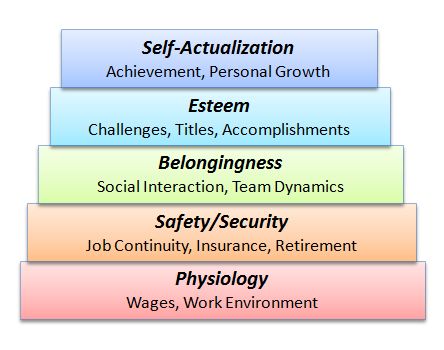
Sometimes improving team performance requires getting back to basics. Remember Maslow’s hierarchy from psychology class? Maslow proposed that humans have five categories of needs, and the most basic of these (physiology & safety) must be met in order for an individual to achieve their higher level needs (belongingness, esteem, & self-actualization). Basically, if we don’t have food and water, we’re not worrying about fulfilling our creative potential. Reality isn’t that simple, obviously, but the concept provides a good starting point for understanding individual motivation within an organizational context.

Maslow

It’s common for managers to jump to the upper levels of the hierarchy and focus their efforts on things like team building, recognition, and professional development. And these are great strategies. But it’s important to remember that an individual’s lower level needs must be met as well. You may have little control over some base factors, like your company’s wage structure or retirement plan, but you can greatly influence your team’s work environment and their sense of stability.

Like food and water, employees need adequate resources and equipment to do their jobs. Eliminating outdated technology, convoluted processes and unbalanced workload goes a long way toward improving individual motivation. As a leader, you can also create a safe, non-threatening environment by curtailing inappropriate email or other unprofessional team behavior that may leave individuals feeling uncomfortable.

To insure a sense of security, your management policies should be clear, consistent and objective. Arbitrary decisions, conflicting priorities and mixed messages all undermine team stability. Sharing information also helps your team understand the context of their work and what to expect from both you and the organization. Providing details of organizational strategy and impending changes (where appropriate) will help your team feel more secure in their positions.

You might also consider using Maslow’s hierarchy as a starting point when crafting your management philosophy statement.

Notes To Self: Tracking Your Deliberate Practice

tracking your deliberate practice

A deliberate approach to improving your management skills requires analysis and reflection. It’s important to record what and how you practice, the results of new tools or techniques, and your daily management observations.

In Writing Down the Bones, Natalie Goldberg describes how William Carlos Williams, a pediatrician and poet, often wrote on prescription pads between patient visits. As a result, his works contain many prescription-pad-sized poems. I’m reminded of this story whenever I start a fresh notebook. “Our tools affect the way we form our thoughts.”

How you record your practice is a personal choice but I recommend experimenting with different formats. If your day is spent in front of a keyboard, using pen and paper for your management observations may offer fresh inspiration. If your workspace is covered in post-it notes, transferring those thoughts to a Word document or electronic journal may help you see themes and patterns. Blogging your practice can also be productive, as it forces you to organize your thoughts for others to read.

If you struggle with remembering to record your practice, iDoneThis offers a free service that I’ve found useful. They send you a reminder email at the end of each day and you simply reply with what you’ve accomplished. Your responses are automatically saved to your personal calendar for later review. To make this tool most effective, combine it with a scheduled block of time to reflect on your daily “dones” and draft a plan for integrating what worked into your management toolkit.


(Hat tip to Dan Pink for recommending iDoneThis.)


This post contains affiliate links to Powell’s Books.


Doing it better.

“Any activity becomes creative when the doer cares about doing it right, or doing it better.”
– John Updike

What management task are you dreading this week? Writing a performance review? Creating a project budget? Facilitating a meeting?

Perhaps there is a tool or technique you haven’t tried before. Or an opportunity to collaborate with a teammate. Try something that will make your work better and see if your motivation improves as well.

Deliberate Practice for Managers

practiceEver wonder what separates Tiger Woods from the average golfer?  Or Jimi Hendrix from the guy in your neighbor’s garage band?  Behold, the power of deliberate practice.

The basic idea is that star performers in music, sports or other fields are not born great; they rarely have some innate mental or physical advantage that average performers do not.  Their achievements are actually the result of hours upon hours of very targeted effort.  Skills are broken down into discrete blocks and those blocks are practiced regularly and with increasing intensity.  The performer seeks feedback and results are diligently recorded, tracked and analyzed for improvement.

So how do we use this idea to improve our performance as managers?

First, we can identify a single competency and focus on improving in that area until we achieve mastery.  Unlike perfecting a golf swing or a guitar riff, management may seem too complex to lend itself to task repetition.  But there are core skills, such as presenting information or facilitating a meeting, that can be honed until they become second nature.

In addition, we can be careful observers of ourselves and others.  As we encounter management challenges, we can reflect on them in an analytical way.  “How did that interaction go?  What did I do well?  What could I have handled differently?”  We can record these observations and use them to gauge our progress over time.

Similarly, we can observe others.  Is there a peer or superior who is strong in a key management area?  Watch and record what makes them successful.  Reflect on it, analyze it, and try to bring those skills to your own work.  Perhaps that person can be enlisted as a personal mentor or coach.

Finally, we can utilize “what-if” scenarios to analyze how we would handle challenging management situations.  Business schools often use case studies to help students solve real-world problems.  Using this approach in our management practice allows us to hone best-practices and refine our management philosophy.

Recommended Reading:


This post contains affiliate links to Powell’s Books.