Tag Archives: Career Advice

Management Tip of the Week: March 21, 2014

For the best snow cones in the Valley.

This tip comes from Veronika Sonsev, CEO and cofounder of InSparq, via an interview with Anne Libby on the iDoneThis blog:

“First, [Sonsev] finds out the top three goals you want to have on your resume when you leave the company, and then the top two things you want her to say about you in a recommendation.  Then every week, she does a planning session to figure out how to get you one step closer to those bullet points.”

What an engaged, thoughtful approach to management!  It recognizes that, as an employee, your resume is one of your most valuable assets. Sure, we should all be driven by passion for our work and  dedication to the organization.  But as managers, we need to realize that people have career aspirations beyond their current position.  Helping your team grow as individuals and professionals is one of the coolest things about being a leader.

What do you think?   Is this an idea you could implement as a manager?


(Photo by Aaron Stidwell via Flickr, licensed under Creative Commons)


Use that boring meeting to flex your management skills.

Donuts by Dave Crosby (cropped & saturated)

Let’s talk about business meetings.  Yes, the bane of our professional lives.  Those endless sessions where everyone is talking in circles and no one can seem to get to the point.  Time, and your life force, is trickling away before your eyes.

“Why is no one controlling this?” you wonder. “Shouldn’t someone step in and move this forward?”

Yes, someone should.  And knowing how to do so can be a huge asset to your career.  It’s relatively simple but, like most interpersonal skills, it does take a little gumption and finesse.  And here’s the bonus kicker:  it’s a skill that will also serve you well as a manager.

Great managers are clear thinkers who are able to sort through tons of information and break it down into meaningful actions.  They have a cohesive effect on their teams by helping everyone stay focused on a clear goal.  Great managers are awesome facilitators who are able to direct events toward a positive outcome.

Now, don’t you wish you had someone like that in those meandering, time-sucking meetings? Everyone does.  That’s why meetings are the perfect place to practice your management skills and demonstrate your ability to lead.  Here’s how:

Be aware of the reasons meetings are unproductive:

  • lack of a clear direction;
  • getting bogged down in detail, or
  • drifting off into high level visioning;
  • dominant and/or withdrawn participants;
  • personal agendas

Always practice effective listening.  I’ve covered this topic in the classroom, so I know you just rolled your eyes.  Yes, it’s basic stuff but I stand by its importance.  Be attentive and engaged, both mentally and physically.  Focus on the speaker, listen to what they’re saying and how they’re saying it.  Look for nonverbal cues and other subtle dynamics.  Fight the urge to zone out or work on other projects.  And most importantly, get in the habit of taking notes.

Learn to summarize and paraphrase.  Here is where your note-taking comes in.  Recording key words and phrases helps you focus in on the most important information being covered.  Check for understanding by conveying the information back simply and concisely.  Put the information into your own words but without questioning or judging.  Your goal is to facilitate, not force your own agenda or dominate the meeting.

Be respectful.  A warm, friendly and humble demeanor goes a long way.  If you’re not officially leading the meeting, be careful of overstepping.  Practice a few phrases to help you act as a clarifier, and be seen as leader, without insulting the meeting organizer.

            “I’m having trouble following multiple threads here. Could we focus on ____ ?”
            “Can we take a moment to recap?”
            “Just to make sure I’m clear, we’re saying ____”
           “Let me make sure I’ve captured this, our actions items are ____.”

And, ultimately, it never hurts to be the one who brings the donuts.


(Photo by Dave Crosby via Flickr, licensed under Creative Commons)


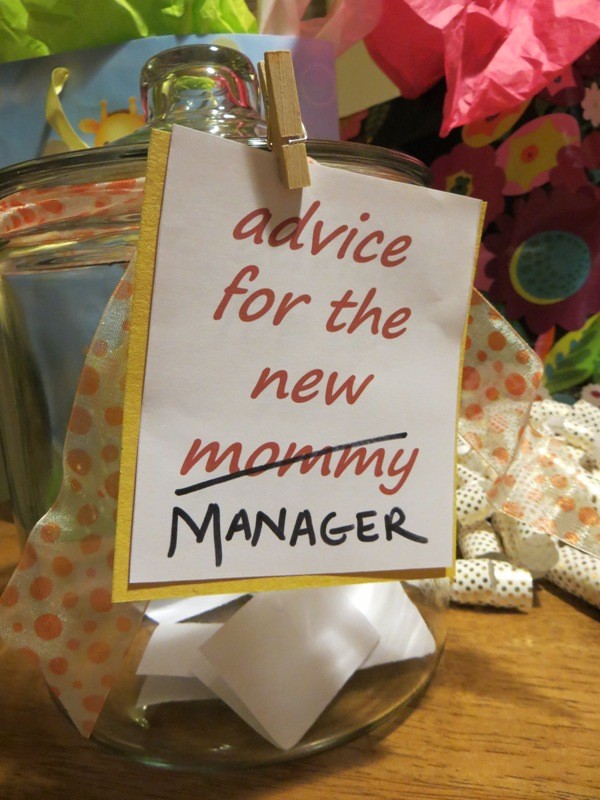
Advice for the new manager.

advice for new manager

Over the weekend, I helped throw a baby shower for a good friend, and as I watched folks gather to offer their support and congratulations, it occurred to me:

Wouldn’t it be great if we threw a shower for a new manager?

Like parents-to-be, new managers are embarking on a new stage of their lives. They’re taking on unfamiliar tasks and new (terrifying) responsibilities.  Wouldn’t it be nice to shower them with gifts and good wishes?  Shouldn’t we come together to give them the tools and support (and cupcakes) they need to embark on the management journey?

While fun to imagine, it’s probably not going to happen.  But one element of the baby shower that did stick with me was the opportunity for guests to share a piece of advice for the new parents.

“Sleep when the baby sleeps”         “Always carry two of everything”

As I wrote down my words of baby wisdom, I considered what I would write if I could only give one piece of advice to a new manager.  Here’s what I came up with:

It’s okay to admit you don’t know everything.  Your team knows you’re new to this.  Be confident in your abilities but ask for help when you need it.  Your team will respect you for it.

How about you?  What singular piece of advice would you give to a new manager?


What are you good at?

Compass by Vero Villa

I’ve been feeling a bit wobbly lately.  Lacking a clear direction.  Not pointed toward my True North.

When I was teaching and students came to me struggling with direction – choosing a major or drafting their resume – I would recommend that they start with the most basic questions:

What are you good at?       What are you bad at?

Simply stepping back and answering those two things can help you cut through the mental clutter and see things more clearly.

So here’s me following my own advice:

I am good at…

Managing people.  Building teams, evaluating performance, helping people grow.

Presenting information.  Sorting data, seeing connections, making it all look pretty.

I am bad at…

Networking.  All the awkward discomfort of mingling at a cocktail party without the alcohol.  Thank you, no.

Technology.  I’m proficient enough to do what I need to do but don’t care enough to really understand it.  I am certain my son will surpass me technologically by the age of 4.

Navigation.  I have no sense of direction.  I can (and will) get lost at the mall.  This doesn’t have a strong career implication but is something you should know in case we’re ever in a survival situation together.


How about you?  What are you good and bad at?


(Photo by Vero Villa via Flickr, licensed under Creative Commons)

The key to landing your dream job.

Key 4 - Brenda Starr

We all want to find our dream job.  The job that makes us feel energized and excited.  The job that helps us live our best life – financially, physically and intellectually.  But how do we get that job?  By following our passion?  Maybe.  By being a master networker?  That helps.  But I believe it comes down to something much more fundamental: having options.

Having options means you can explore different positions and different industries. You can apply your skills in new and creative ways until you find the job that truly fits.  When you have options, you have the freedom to control your career.

So, how do you make sure you have options?  By creating equity.  And by equity, I mean having more career assets than career liabilities.  Here’s what it looks like:

Job skills are an asset.  When you have more skills than you need to meet the requirements of your current job you have equity.  You can then take those excess skills and apply them to new challenges.  And then to a new position.  Then a new career.  As your job equity grows, so do your options.

  • Update your resume frequently.  Identify areas where you are weak, then focus your attention on building those skills.
  • Volunteer for projects that build new skills, even if it means extra work.
  • Utilize educational opportunities, via in-house training or through your company’s educational reimbursement program.
  • Take on team leadership.  Skills in managing people are highly marketable and can be applied across disciplines.

Money is an asset.  When you have more money than you need to meet your basic needs you have equity.  By living within (or well below) your means, you build a financial cushion that keeps you from being trapped in your current situation.  You have the freedom to take a pay cut in order to explore a new field.  Or to relocate for that once-in-a-lifetime position.  As your financial equity grows, so do your options.

  • Create a realistic budget and stick to it.
  • Keep at least 6 months living expenses in your savings account.
  • Avoid consumer debt.  Fight the temptation to use your credit card for things you don’t need.
  • Explore the myriad of budgeting and financial planning resources available online.


How about you?  How have you created equity in your career?


(Photo by Brenda Clarke via Flickr, licensed under Creative Commons)

How to fight job burn-out.

up in smoke

I have two friends who are struggling in their professional lives.  One loves his job.  One hates her job.  But both are feeling much the same: overwhelmed and burned-out.  They can’t seem to get on top of everything they need to do and they’re starting to feel that work is controlling their lives.  Perhaps you’re familiar with this feeling?

Here’s the advice I pulled together for both of my friends:

Keep work in its place.  Are you on your laptop right up until the time you go to bed?  Do you use your iPhone to check email before you get out of bed in the morning?  Stop that. Now.  I know, you need to do some work at home.  Most people do.  But give yourself some time to wind-down and turn off your work brain before climbing into bed.  It will help you sleep better and be more relaxed.  And yes, I know that occasionally you catch an issue before it escalates by checking email first thing in the morning.  But I’m willing to bet that most days everything can, and will, wait until you get to the office.  Buy an alarm clock so you can leave your phone outside your bedroom.  And buy a watch so you won’t be tempted to check-in every time you check the time.

Make lists.  Having a targeted task list is key to feeling in control of your work load.  Most productivity advice recommends keeping your list short- say 5 or 6 of the most important things you need to accomplish.  Adam Wik from Road to Epic lays out a brilliant strategy for beating apprehension and indecision (the twin demons of procrastination).  Read his post, then start taking time at the end of the day to prep your to-do list for the following day.  Then spend another 5 minutes listing the things you are grateful for.  Okay, I just heard you groan.  I know, I know.  But trust me, whether you love or hate your job, noting the many good things in your life will make work problems seem smaller and more manageable.  And, although it doesn’t always seem like it, time passes swiftly, my friends.  Keeping a gratitude journal will help you mark that passing and remember who you were at this point in time.

Practice mindfulness.  Being overwhelmed at work can make you feel out of control in all the other areas of your life as well.  Take time to center yourself and reclaim your sense of calm.  If a daily guided meditation isn’t your thing, maybe it’s a walk through the woods or listening to Coltrane in the dark.  But as Britt Reints beautifully points out, “the world spins no matter what we do”.  All we can truly control is how we respond to it.  And everything works better when we respond from a place of calm.

How about you?  What advice would you give to a friend struggling with job burn-out?

(Photo by Robert Bieber via Flickr, licensed under Creative Commons)

Get in the Mood: Creating a Manager’s Inspiration Board

radiant quote 2

I’ve always loved inspiration boards.  As a teenager, I covered my bedroom walls with layers of Benetton ads and poignant hair-band lyrics.  (Just like every night has its dawn…every rose has its thorn.)

These days, my inspirations have changed but I still like to look up from a tough problem, or lean back after a difficult call, and see the things that inspire me…as a manager, as a writer and as a mom.

Ann Friedman suggests that our teenage bedroom and locker decorating has evolved into the current popularity of Pinterest and Tumblr.  And while I like those mediums, I’m inherently more tactile.  And lazy.  I need my inspirations to be accessible without requiring the foresight to open my web browser.  So I recommend having the things that inspire you as a manager on an actual board (or cube wall or clipboard or whatever you’ve got).

With all that in mind, here are some ideas for creating a Manager’s Inspiration Board.

Inspiring or motivational quotes – The one above from John Butler Yeats is a favorite reminder to myself to keep finding new challenges.

Your dream workspace – Designers use mood boards to capture the atmosphere or feeling they want to create in a new space.  You can do this, too, with clippings, fabrics and color swatches.

Elements of your management philosophy – What management truths do you hold to be self-evident?

Your personal, and/or your company’s, mission statement – Ideally, these two things are in harmonious synergy.

Symbols of why your job matters to you – Maybe this is a picture of the people you serve.   Or your smiling team after a productive retreat.   Or your kids.

Ideas to revisit – Include a place to capture all your brilliant, but not really applicable at the moment, ideas.


How about you?  What things are on your inspiration board?


The fast-track from entry-level to management in 5 (sort of) easy steps.

5 steps

Many moons ago, I started my career in business by taking a temp job at a tech company.  I had a degree in Anthropology and a limited background in museum administration.  I needed a job and, although it wasn’t exciting, this basic admin gig paid pretty well.  After a few months as a temp, I was hired on as an AR Specialist, and when I left the company 5 years later, I was an MBA leading a successful team.

Here’s what I learned in those 5 years:

Get good at your core tasks – fast.
Assuming you’re smart and willing to work (and I truly assume that most people are), this isn’t hard to do.  Basic efficiency goes a long way.  Show you can work quickly and effectively, then ask for more challenging tasks.  It helps if you can make a visible impact in some way, even if it seems super basic.  When I took the temp job, my office was in the file room, where mountains of paper was left unfiled, causing everyone to spend way too much time finding what they needed.  I’m a fast worker and I quickly tackled the problem, taking a very visible roadblock out of the my team’s way.  And I was quickly given more interesting things to do.

Join a cross-functional project team.
This introduces you to other areas of the organization and lets you get to know people on other teams.  Representing your area on a project makes you the default subject matter expert.  To use myself as an example again, when the Marketing team or the IT team needed something from AR, they came to me because they knew me from a project.  It’s actually startling how fast you can become the go-to person and subsequently, how rapidly your visibility within the organization increases.

Be a dependable problem-solver.
This is really a component of all the other points but I think it’s worth reiterating.  Being the go-to person on your team means being willing to help everyone.  Be a team player, be accountable and always follow-thru.  You’ll quickly become known as someone who gets things done.

Take a management position, even if you think you’re not ready.
Subject matter experts, who are known company-wide as dependable players, get promoted to team leaders.  Now, from an organizational standpoint, I don’t think this is a great idea.  Being good at what you do doesn’t mean you’ll make a great leader.  Particularly without proper training and mentoring.  But it happens, and as an individual, it’s worth capitalizing on.  Once you’re in the role, do your homework, figure out best practices and help your team achieve.  And help them both as a group and as individuals.  You’ll look extra great if your team members are fast-tracking their careers too.

Continue your education.
I’m often asked if I recommend pursuing an MBA.  My response is always “it depends”.  Should you jump into grad school right after college?  Maybe.  Should you go to grad school if your company is paying for it?  Absolutely.  I got my MBA while working full-time, which was exhausting, but I also had a ton of fun with a bunch of people going through the same thing.  And more importantly, I got more value out of both work and school because I was able to apply what I was learning every day.

The next question is always whether an MBA opens doors.  Again, “it depends”.  It probably won’t get you a job but it might get you an interview.  And if you’re looking to move up at your current company, and you’ve done everything I’ve outlined above, it’s priceless.  You’re already visible across the organization, you’re proving yourself as a leader and you’re working your butt off to get an advanced degree?  People will notice.


How about you? I’d love to hear your experiences on the path to management.


(Photo by Chris Wightman via Flickr, licensed under Creative Commons)


Three ways to help your team navigate their careers.

ladder In Lean In, Sheryl Sandberg notes that she prefers the jungle gym over the ladder as a metaphor for the modern career. A jungle gym lets the climber move in a variety of directions, trying different approaches and learning new positions. And it offers better views for everyone:

“On a ladder, most climbers are stuck staring at the butt of the person above.”

What kind of view are you giving your team? Can they see the whole playground? Or are they staring at your butt, hoping you fall so they can move up?

Here are three ways to insure everyone has a place on the jungle gym:

1. Hire smart people and encourage them to work themselves out of a job. Reward system and process improvements that minimize repetitive tasks and free your team to take on more challenging opportunities.

2. Offer cross-training and professional development opportunities. Insure your team has deep industry and company knowledge so they can add value at a higher level.

3. Understand each individual’s long-term career goals and encourage them to explore their interests. Utilize your cross-functional knowledge to identify opportunities for your team outside your workgroup.


You might also like:

Are you meeting your team’s needs?


This post contains affiliate links to Powell’s Books.


(Photo credit: Microsoft)


How do you survive a job you hate?

Out of Office by Everjean

Being stuck in a job you hate is draining – mentally, physically and emotionally.

You’re unmotivated, unproductive and unhappy. 

How do you get through it?  Here are three tips that have helped me in the past.

And as I wrote this, I started thinking about the flipside of the question:  How do we as managers make sure our employees aren’t stuck in jobs they hate?  Interestingly, the same advice applies in both cases.

Fight negative self-talk

There’s a voice inside your head that narrates as you go about your day, and sometimes it says the same negative thing so often that you don’t even realize it has become your mantra:

“Ugh, I hate this place.”      “I’m trapped.”      “This sucks.”

This inner curmudgeon is hard to ignore and only serves to make you feel even worse about your situation.  But if you can become conscious of your own self-talk, you can stop the voice before it starts.  When you hear your inner dialogue start to take a downward turn, pull up some positive phrases to counteract the negative voice.

“I feel good today.”       “I can do this.”

It won’t change the realities of your job but it will help you feel better as you do it.

The flipside…

As a manager, you obviously can’t change an employee’s inner voice.  But you can insure that your workplace culture doesn’t promote complaining and negative cross-talk.  Keep lines of communication open between you and your staff by creating a space for genuine feedback in your team meetings and one-one discussions.  Encourage your staff to bring their negative opinions into the open so you can actually deal with the underlying issues.  And don’t forget to make sure you’re curbing your own inner critic as well.

Focus on growth

It’s tempting to check out of a job you hate… zoning, surfing the web, napping in your car.  While it seems like focusing on anything other than your job will cheer you up, the reality is that we need to be challenged to be happy.  Simply “doing your time” will make the days even longer and yourself even more unhappy.  So use the time you’re stuck in a bad job to grow your professional skills.  Take on a new project, rework a process or try a new technique.  Challenge yourself to learn something new every day.  The days will go faster and you’ll be beefing up those weak points in your resume to boot.

The flipside…

As a manager, this one is pretty straight forward.  Make sure your team has challenging work and the opportunity to try new tasks.  Cross-training is a great way to keep your employees learning new things while also making your team stronger.  It’s important to encourage your staff to explore projects that are of personal interest as well.  Tune in to your team’s individual career goals and focus on helping them grow.

Tackle big projects in small doses

As much as you hate your current job, you probably need to find a new one before you can move on.  Even if jobs are plentiful and you’re a hiring manager’s dream, job hunting sucks.  When you’re drained and demoralized from 8 hours on the job, the last thing you want to do is spend your free time writing cover letters.  But if you want to find a better job, you’ve got to tackle the process.  If this seems daunting, work in small doses.  Commit to working on the job hunt for 15 minutes every night.  It won’t seem so overwhelming and you’ll be able to get a surprisingly large amount accomplished in a week.

The flipside…

As a manager, make sure you’re paying attention to your team’s workload and let them know they can come to you when they’re feeling overwhelmed.  Coach them on how to approach large tasks and help them find smaller side projects that they enjoy.  This will give them something to focus on when they’re feeling burnt out on their main project.


How about you?  How have you gotten through a job you didn’t like?


(Photo by Everjean via Flickr, licensed under Creative Commons)